
Why Hard Work Stops Working — And What Small to Mid-Sized Businesses Often Miss
You can be busy all day and feel like progress is happening, but still never actually move the needle. Many teams and leaders blame tools, budget, or outside partners when growth stalls. The real culprit is misalignment — lack of clarity in leadership, systems, and execution. When teams are busy but directionless, work becomes friction, not momentum.
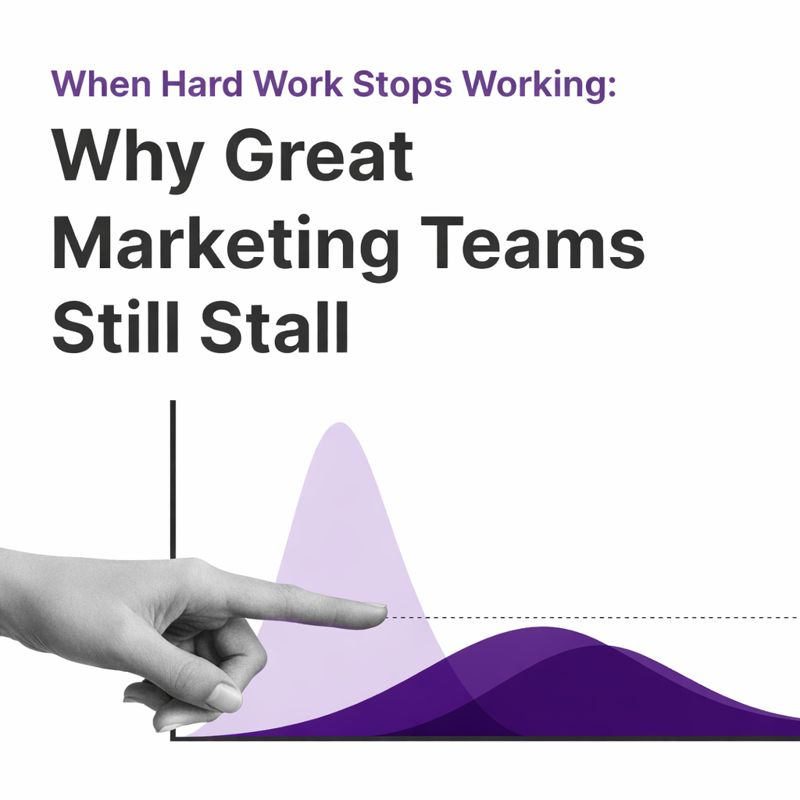
So much of marketing feels like a treadmill: meetings, campaigns, analysis, reports, optimization, repeat.
You see activity everywhere.
But little actual progress.
You might even be working with skilled people or agencies. That doesn’t matter if your team isn’t aligned around clear goals and execution frameworks.
That’s not an opinion — that’s what hundreds of leaders reported when Disruptive Advertising surveyed business owners and marketers who were frustrated despite putting in effort. The common theme wasn’t lack of talent. It was lack of alignment across leadership, systems, and culture.
This idea is backed by organizational studies: clear alignment between leadership priorities, operational systems, and team behavior is a core predictor of performance. When these are misaligned, hard work becomes noisy motion, not meaningful progress.
The Hidden Costs of Misalignment
People work harder when they feel unclear.
Teams stay busy but don’t produce results because:
• Leadership doesn’t articulate strategy clearly
• Processes are confusing or inconsistent
• Team members prioritize different goals
• Responsibilities overlap or fall through the cracks
Alignment isn’t about everyone agreeing with leadership. It’s about everyone understanding what winning looks like, how they contribute, and how their work connects to measurable business outcomes.
Harvard Business Review has emphasized that strategic clarity — having a shared understanding of objectives and success metrics — is key to execution performance in fast-moving environments. Without it, teams default to activity instead of progress.
Why Tools and Agencies Aren’t the Root Cause
Far too many leaders assume that more technology or the perfect agency will fix stagnant growth.
Let’s be direct:
Technology is a multiplier, not a creator of direction. Paid media platforms, analytics dashboards, project management tools, and AI dashboards will show you where activity is happening — or not happening — but they won’t tell you why.
Meta, Google, and other platforms themselves reinforce this: your campaign performance is determined as much by clarity of goals, audience signals, and execution discipline as by the platforms themselves. That’s something neither AI nor a third-party partner can create for you.
Even the best agencies can feel ineffective if they’re handed a strategy that isn’t clear or supported by leadership expectations and internal systems. Skilled partners amplify execution. They don’t substitute internal alignment.
Growth Comes from Alignment — Not Activity
Clarity creates momentum.
When goal statements, roles, responsibilities, and processes are aligned:
• Decisions happen faster
• Errors decline
• Teams collaborate instead of clash
• Accountability becomes visible
• Progress becomes measurable
If your growth feels like running uphill in sand, it’s probably not because you lack ambition. It’s because your organization’s internal compass points in slightly different directions.
Management research shows that organizations with aligned strategy, culture, and operations consistently outperform peers that rely on individual talent without shared context. This alignment lowers friction and allows teams to execute in rhythm. Marketing Foundations
Teams That Stall Don’t Lack Talent — They Lack Feedback Loops
When work feels busy but not effective, the real issue is feedback. Not data. Not dashboards. Feedback that tells the team:
• What’s working
• What’s not
• What to double down on
• When to adjust
• What success looks like today
Without regular inspection and course correction, teams default to “activity equals progress.” That’s not a strategy. It’s a trap.
Great teams don’t just do more. They learn faster.
Frequently Asked Questions
Read more

What are the Best AI Marketing Tools in 2026?
AI marketing tools are everywhere, but most businesses are still overwhelmed, underperforming, or using them wrong. In 2026, the winners won’t be the companies using the most AI tools — they’ll be the ones using the right tools with clear strategy. This guide breaks down the AI marketing tools that actually matter and how to use them intelligently.

The Influence of Social Media Marketing Activities on Customer Loyalty
Discover how strategic social media marketing activities build lasting customer loyalty. Learn the proven tactics that turn casual followers into brand advocates and drive repeat business for your company.
How To Optimize A Google Business Listing
Most Google Business listings exist. Very few perform. If your profile isn’t driving calls, direction requests, or real leads, it’s not optimized — it’s just indexed. This guide breaks down exactly how to optimize your Google Business listing so it shows up, stands out, and converts.